The certificate says VS1 — but is it really? Shop for a lab-grown diamond and you notice something fast: almost every stone carries an IGI report, while GIA reports are rarer and usually cost more. That raises a fair question the generic “what is IGI” explainers dodge — if the same physical diamond could be graded by either lab, does the choice of certificate change what you’re actually getting? Because we sell both GIA- and IGI-certified stones, we can answer that plainly.
IGI grades the large majority of lab-grown diamonds on the market, and in practice its color and clarity grades tend to run a little more generous than GIA’s on the same stone — often by about one grade, sometimes two on clarity. An IGI “VS1” frequently behaves like a GIA “SI1” once you look closely. Neither lab is “wrong”; they calibrate differently. The fix isn’t to avoid IGI — it’s to mentally adjust an IGI grade down about one step when you compare it against a GIA stone, and to judge the diamond by eye and price-per-carat, not the printed letter.
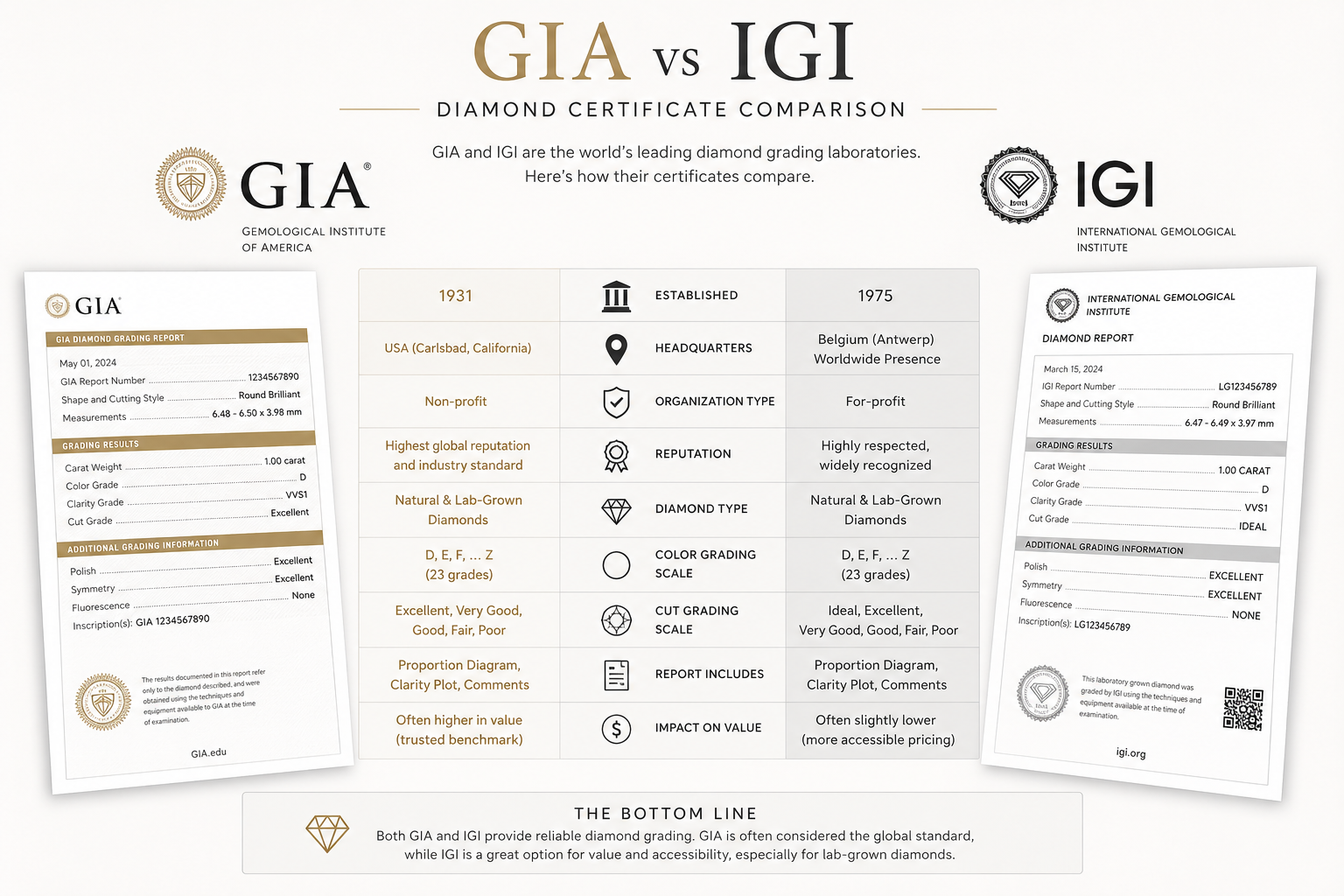
GIA vs IGI at a glance
| GIA | IGI | |
|---|---|---|
| Founded | 1931 (USA) | 1975 (Antwerp) |
| Share of lab-grown grading | The minority — the stricter, premium choice | The large majority of lab-grown reports |
| Reputation | The benchmark, especially for natural diamonds | Reputable and ISO-accredited — the default for lab-grown |
| Grading philosophy | Conservative; grades tight and consistent | Consistent but a little more lenient on color/clarity |
| Turnaround & cost | Slower, pricier | Faster, cheaper (which is why volume flows there) |
The grading gap, in plain numbers
Grading color and clarity is a human judgment made under 10x magnification against master stones, so two reputable labs can view the same diamond and land a grade apart. Across the trade the pattern is consistent: IGI tends to sit about one color grade and one clarity grade above GIA on the same stone, and on clarity that can stretch to two. So an IGI report reading G / VS1 may correspond to roughly H / SI1 on a GIA scale — still a lovely diamond, just not quite what the letters imply at face value. Treat it as a rule of thumb, not a law: stones vary. Our certificate comparison guide shows how the main labs line up across the full color and clarity scales.
Why this shows up specifically in lab-grown
Three things stack up. First, volume: the lab-grown boom runs overwhelmingly through IGI, so that’s the grading you see most. Second, there is no single governing standard legally binding every lab to identical calls — each sets and applies its own, and some are more conservative than others. Third, GIA built its scale over decades on natural diamonds and only moved to grade lab-grown on the same D–Z / Flawless–I3 nomenclature relatively recently (full-grade lab-grown reports arrived around 2020), and it applies that scale tightly. The net effect: the certificate most lab-grown stones carry is also the one that grades a shade more generously. There’s more in our lab-grown diamonds guide and our overview of the individual grading laboratories.
How to compare an IGI stone against a GIA stone when shopping
- Calibrate, don’t panic. Put an IGI-graded stone beside a GIA-graded one and mentally shift the IGI color down ~1 and clarity down ~1–2 before comparing — then it’s like for like.
- Buy the stone, not the paper. Insist on seeing the actual diamond in person or on 360-degree video, and prioritize eye-clean (no inclusions visible to the naked eye) over chasing a letter.
- Compare price per carat at the adjusted grade. A cheaper IGI VS1 is no bargain if, on a GIA scale, it’s really an SI1 priced like a VS1.
- Mind melee and setting. Tiny accent stones in finished pieces are rarely certified — judge those by the maker’s reputation.
- Ask about GIA. If certainty matters, ask whether a stone can be bought with, or re-submitted for, a GIA report. And if you’re weighing lab-grown value against natural, our natural vs lab-grown price comparison lays out the real numbers.
Frequently asked questions
Is IGI legitimate?
Yes. IGI is a long-established, ISO-accredited independent laboratory and the most widely used grader of lab-grown diamonds worldwide. “A little more generous than GIA” is not the same as “unreliable” — IGI is consistent, it just calibrates its scale slightly differently.
Should I avoid IGI-certified lab-grown diamonds?
No. Most lab-grown diamonds you’ll ever see are IGI-graded, and plenty are beautiful, well-cut stones. You simply shouldn’t compare an IGI grade one-to-one against a GIA grade — adjust by about a grade and judge the diamond by eye and by price.
Can a lab-grown diamond be re-certified by GIA?
Yes. GIA issues Lab-Grown Diamond Reports, so a stone currently graded by IGI can be submitted to GIA for its own report. Expect a cost and a wait, and don’t be surprised if GIA returns a slightly tighter color or clarity grade — which is the whole point of this article.
Want a second opinion before you buy? We deal in both GIA- and IGI-certified stones, so we can tell you what a given report really means for the diamond in front of you — book an appointment or browse lab-grown diamonds.