If you have ever wondered what a lab-grown diamond is actually made of, the short answer may surprise you: it is made of exactly the same thing as a mined diamond. This guide explains the raw material, the two methods used to grow them, and why the finished stone is a true diamond in every sense.
Lab-grown diamonds are made from pure carbon, the same element as natural diamonds. They are created in two ways, High Pressure High Temperature (HPHT) and Chemical Vapor Deposition (CVD), both of which build a real diamond crystal atom by atom on a tiny diamond seed. The result is chemically and optically identical to a mined diamond.
The raw material: pure carbon
A diamond, whether grown in a lab or formed in the earth, is simply carbon atoms arranged in a rigid crystal lattice. That structure is what makes diamond the hardest natural material known, a perfect 10 on the Mohs scale. Lab-grown diamonds start with a small diamond seed and a carbon source, then recreate the intense heat and pressure, or the carbon-rich gas, needed for more carbon to bond onto that seed. You can see how this shared structure affects grading in our diamond education guide.
Method 1: High Pressure High Temperature (HPHT)
HPHT mimics the conditions deep inside the earth. A diamond seed is placed with a carbon source, usually graphite, inside a chamber that applies enormous pressure (around 1.5 million pounds per square inch) and temperatures above 1,400°C. The carbon melts and then crystallizes onto the seed, growing a larger diamond. HPHT is the older of the two methods and is also used to improve the color of some diamonds.
Method 2: Chemical Vapor Deposition (CVD)
CVD is the newer, increasingly popular method. A diamond seed is placed in a sealed chamber filled with a carbon-rich gas such as methane. The gas is heated until it forms a plasma, releasing carbon atoms that settle onto the seed layer by layer, growing the diamond upward like a crystal skyscraper. CVD allows precise control over quality and is well suited to producing large, high-clarity stones.
How long does it take to grow a diamond?
Where a natural diamond forms over one to three billion years, a lab-grown diamond grows in a matter of weeks. A one-carat stone typically takes around two to four weeks depending on the method and the quality being targeted. After growth, the rough crystal is cut and polished by skilled cutters, exactly like a mined diamond.
Are they really the same as natural diamonds?
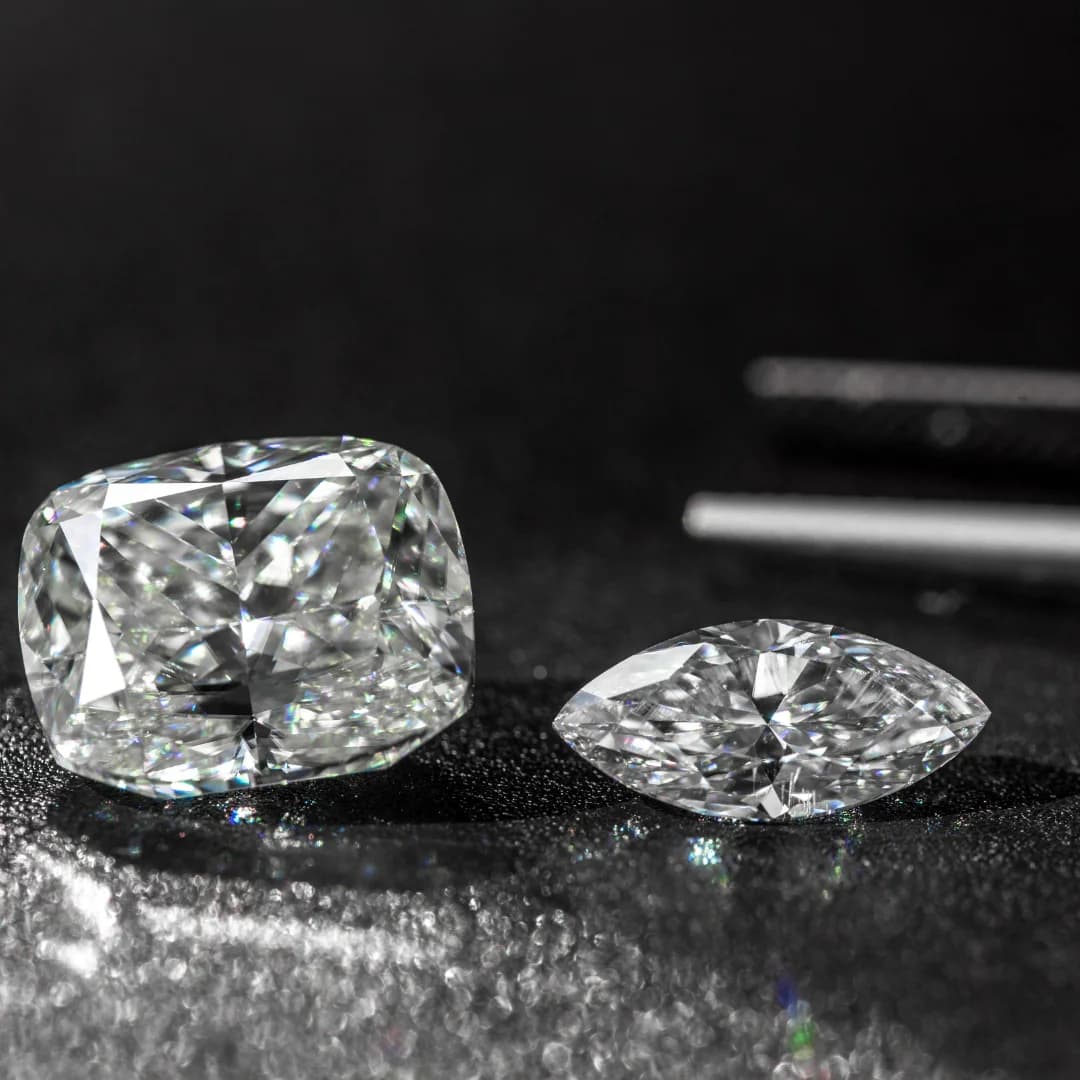
Yes. Because they share the same carbon crystal structure, lab-grown diamonds have the same hardness, brilliance, fire, and sparkle as natural diamonds. They are graded on the same 4Cs and certified by the same laboratories, such as GIA and IGI. They are completely different from simulants like cubic zirconia or moissanite, which only look like diamonds but are made of other materials.
Why this matters when you buy
Because the material and the result are identical, choosing lab-grown is really a choice about price and origin, not quality. That is why a lab-grown engagement ring or pair of diamond earrings can cost far less than a natural equivalent while looking exactly the same. Compare the numbers on our price comparison page.
Frequently asked questions
What element are lab-grown diamonds made of?
Pure carbon, the same single element that makes up natural diamonds. Nothing else is added to the crystal itself.
Which is better, HPHT or CVD?
Neither is inherently better. Both produce genuine, high-quality diamonds. What matters is the final stone’s 4Cs and certification, not the growth method.
Can a jeweler tell a lab-grown diamond from a natural one?
Not by eye. Because they are physically identical, telling them apart requires specialized laboratory equipment. That is why certification is so important.
Curious to see them in person? Explore certified lab-grown diamonds at Rêve Diamonds.