How Much Should a Lab-Grown Diamond Ring Cost?
Less than you think, and a good deal less than the mined equivalent. That's the honest headline. The exact figure depends on the size and quality of the stone and the setting you put it in, but the whole point of going lab-grown is that your money stretches much further. Here's what to actually expect to pay, from someone who prices these every day.
The short version
As a rough guide, a one-carat lab-grown diamond of good color and clarity sits around $900 to $1,900 for the loose stone. Put it in a decent ring and you're usually looking at $1,500 to $3,200 all-in, depending on the metal and setting. The mined version of that same ring could easily be three or four times the price. These are guide figures for 2026; your final number always comes down to the exact stone and setting you pick.
What you're actually paying for
Price comes down to the four things every diamond is graded on: cut, color, clarity and carat. Carat weight is the biggest lever, and price climbs steeply as you go up, because bigger rough is harder to grow cleanly. Cut is where I'd never cut corners, it's what makes a stone sparkle. Color and clarity you can be smart about: a near-colorless stone next to a top-color one looks identical on the hand for a lot less, and an eye-clean stone with a tiny inclusion you can't see costs far less than a flawless one.
Typical prices by size
Half a carat tends to land around $400 to $800 for the stone. One carat, as above, roughly $900 to $1,900. Two carats jumps to something like $2,200 to $4,500, because that steep carat curve really shows at the top end. These are ballpark loose-stone figures for sensible everyday quality, not the rock-bottom or the very finest.
Shape matters too. Round brilliants carry the highest price per carat, because they waste the most rough in cutting and they're the most in demand. Fancy shapes like oval, emerald and cushion usually cost less for the same weight, which is another easy way to get a bigger look for your money without dropping quality.
Don't forget the setting
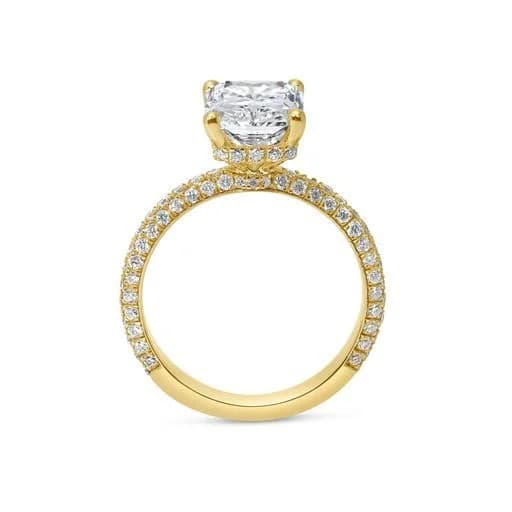
The stone is only part of a ring. A plain solitaire band in gold might add a few hundred, while a more involved design with side stones or a fancy mount can add a good deal more. It's worth deciding early how you want to split the budget between the center stone and the setting, because that's the choice that shapes the final price more than anything.
How that compares to a natural diamond
This is where lab-grown earns its keep. The same one-carat stone in a mined diamond might run $5,000 to $7,500 or more, several times the lab-grown price for something that looks the same on your finger and grades the same on paper. If you want the full breakdown, our lab-grown vs natural guide and the price comparison lay it out side by side.
Why prices have been falling
Lab-grown prices have dropped over the last few years as growing capacity scaled up, and that's straightforwardly good news if you're buying now, you get more stone for your money than you would have in 2022. The flip side is that these aren't an investment and resale is low, which we cover honestly in do lab-grown diamonds hold their value. Buy for the ring you'll wear, not for a return.
Getting the most for your budget
A few simple moves stretch the money a long way: prioritise cut, drop to near-colorless rather than top color, pick an eye-clean clarity instead of flawless, and always insist on a GIA or IGI certificate so you know exactly what you've bought. Do that and a modest budget buys a stone that looks like a much bigger spend. Our lab-grown diamonds guide goes deeper, the lab-grown diamonds range shows current stock, and if you're ring-shopping, start with engagement rings. For the wider case on choosing lab-grown at all, see why choose lab-grown diamonds.
Frequently asked questions
How much does a 1 carat lab-grown diamond cost?
Roughly $900 to $1,900 for the loose stone at good everyday quality, depending on cut, color and clarity. In a ring, expect around $1,500 to $3,200 all-in.
Are lab-grown diamonds cheaper than natural diamonds?
Yes, usually by a wide margin, often a third to a half of the natural price for the same carat, color, clarity and cut. That price gap is the main reason people choose them.
How much is a lab-grown diamond engagement ring?
It depends on the stone size and the setting, but a one-carat lab-grown engagement ring commonly lands around $1,500 to $3,200. Bigger stones and more elaborate settings push it up from there.
Why are lab-grown diamonds cheaper?
They're grown in weeks rather than mined over billions of years, with a shorter, more efficient supply chain. As growing capacity has scaled, wholesale prices have fallen and retail with them.
Do lab-grown diamonds get cheaper over time?
Prices have fallen in recent years and have broadly settled. That's great for buyers today, but it also means you shouldn't expect a lab-grown diamond to rise in value.
Is a lab-grown diamond worth the money?
As a stone to wear, yes, you get a real diamond and usually a bigger or cleaner one for your budget. Just don't buy one expecting resale value, since that's low.