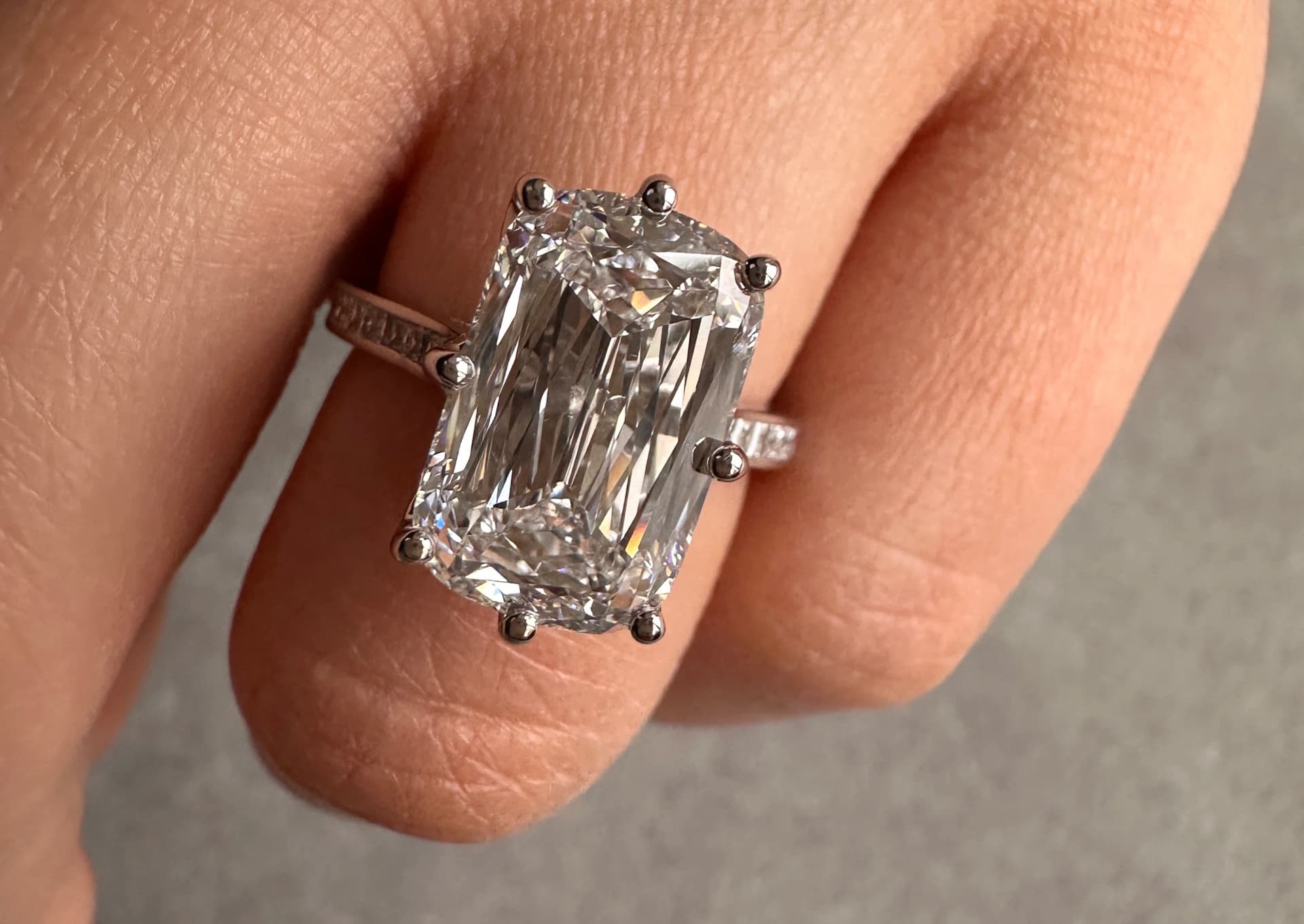
‘Diamonds are a girl’s best friend ’sang Marilyn Monroe in the iconic 1953 movie ‘Gentlemen Prefer Blondes ’
Diamonds form 90-150 miles below the Earth's surface at 2,000°F+ from pure carbon, while colored gemstones like sapphire and ruby crystallize at shallower depths from corundum (aluminum oxide) and emeralds from beryllium-rich beryl. Diamond's Mohs 10 hardness exceeds every gemstone; ruby and sapphire tie at Mohs 9. Lab-grown diamonds replicate the same geology in 2-4 weeks.
, and there is no doubt that the love affair that women have with diamonds has survived decades. Diamonds have an irresistible charm and a fascination that lasts eternity (even beyond a relationship in some cases!) as the lyrics of this song illustrate: “Men grow cold / As girls grow old / And we all lose our charms in the end / But square-cut or pear-shaped / These rocks don’t lose their shape / Diamonds are a girl’s best friend.” When we think about an engagement ring or special piece of jewelry we automatically envisage the centrepiece being a white diamond. But there are many other choices of fancy natural colored diamonds such as black, yellow, red, even pale pink – practically a color for every diamond lover. But is choosing to have a fancy natural colored diamond on your engagement ring or necklace a wise choice when there are so many beautiful colored gemstones available such as stunning blue Sapphires, the passion of deep red Rubies, the delicate beauty of an Emerald etc., that can also look beautiful set in a ring or piece of jewelry? Putting to one side the difference in price between diamonds and gemstones, we look at how diamonds compare to gemstones and if they REALLY ARE a girl’s best friend?

How and where are gemstones and diamonds formed and what are the differences in formation?
Diamonds are in fact categorised as ‘gemstones’ this is because all gemstones are rare naturally formed crystals which are made from certain elements or compounds. One of the differences between diamonds and gemstones is that gemstones such as sapphires, emeralds, rubies etc are created in rocks found in the earth’s crust approximately three to 25 miles beneath the earth’s surface. In contrast diamonds are formed much deeper in the Earth’s surface, even as deep as 750km down into the Earth Gemstones are formed in rocks of which there are three kinds within the earth’s crust – sedimentary, igneous, and metamorphic.
Sedimentary rock is formed by the deposition and successive cementation of material at the Earth’s surface within bodies of water. When water mixes with the minerals present on the Earth’s surface rock is worn away. Fragments of mineral rich water and wind seep down into the cracks and cavities within the Earth’s surface where they deposit layers of minerals which over time are compressed so forming gemstones. These gemstones include Opal, Zircon, Jasper and Malachite.
Igneous rock can be formed either by the cooling and crystallization of magma beneath the earth’s surface (intrusive/plutonic) or by lava flowing to the earth’s surface (extrusive/volcanic). Interlinking crystals grow within intrusive igneous rock, sometimes forming gemstones depending on (1) if elements are present (2) the cooling time and (3) the environment. For example, in deeper environments, the slower the cooling time and therefore the larger the gemstone is. Gemstones are formed in extrusive igneous rock when molten magma with temperatures of between 700 °C to 1300 °C runs through the rock and then reach the surface as lava. If the magma doesn’t reach the surface, it cools more slowly, crystallising and forming coarse-grained minerals. Gemstones found in igneous rock include Amethyst, Citrine, Ametrine, Moonstone, Diamond, Tanzanite, Topaz and Zircon.
Metamorphic rock is formed when intense underground heat and pressure change pre-existing minerals into something new. the underground pressure forces minerals and elements that are already there to form into beryls. These gemstones include Emerald, Aquamarine, Jade, Ruby and Zircon. One of the most significant differences between diamonds and other gemstones lies within the formation of a diamond. Diamonds are the only gem formed from highly pressurised carbon which is a single element. Other varieties of gemstones are formed from compounds of two or more elements e.g. sapphires are a variety of the mineral corundum, an aluminium oxide. The sapphire’s intense color comes from traces of elements such as iron, titanium, chromium, copper, or magnesium.
What causes the price difference between diamonds and other gemstones?
There is a notable difference in price between diamonds and other gemstones. The reasons for this are that the price of gemstones responds to normal market pressures of demand supply, but this is not the case for diamonds. There is a monopoly on the price of diamonds, as they are held artificially high. Plus, a huge quantity of diamonds are also being held in storage in order to create a shortage and so keep the price up. This price manipulation is allowed in diamonds but prohibited for other gems and precious metals. The characteristics of diamonds ‘v’ gemstones also contribute to the difference in value. Whilst white (colorless) diamonds are the most common type, as has been noted previously natural fancy colored diamonds are also found in different parts of the world. This makes diamonds very rare and the rarer the diamond, the higher the price will be. Traditionally, the value of a gemstone is determined using the naked eye. Aside from rarity, the value of a gemstone goes higher if it looks older. Diamonds, on the other hand, are analysed and valued using a more systematic system. This system is now being applied to other gemstones as well and is approved by the Gemmological Institute of America (GIA)
Are there any reasons that I should consider investing in gemstones as opposed to diamonds?
Following DeBeers’ exceptionally successful marketing campaign of the 1930s, diamonds became seen as the major investment gemstone. However, some experts believe that the tide may be turning in the world of investment gemstones. In recent years white diamonds have not enjoyed the same increase in price as colored stones like rubies and tanzanite. So, should you consider investing in gemstones? Here are some reasons why:
- Economy and politics are fickle things and gemstones are welcomed as an alternative store of value for those wanting to diversify away from paper investments. Specialists argue that investors should expect to hold a gemstone for 10 years or more before seeing a sizable return on investment, as stones tend to go up at an average rate of 5% p.a.
- Certain precious stones are very rare and therefore particularly valuable. These include:
Tanzanite which is especially rare as it is only found in a small area of four by two kilometres at the foot of Mount Kilimanjaro in the Mayara Region of North Tanzania. The number of chance natural events that created this beautiful stone 585 million years ago means that finding Tanzanite anywhere else on earth is a thousand times less likely than finding a diamond. at the current rate of mining, it is estimated that the available supply will be entirely exhausted within the next 25 years. As a result, tanzanite has been dubbed the ‘gemstone of a generation’ because this generation will be the last with the privilege of buying from the primary market before supply is exhausted.
Rubies are less rare, as they are mined all over the globe. However, for a very long while pigeon blood rubies were only available in Myanmar, and so Burmese rubies still enjoy a certain pedigree. The term pigeon blood refers simply to the brilliant red of the gemstones mined from the Mogok region which is due to the chemical composition of the earth and the conditions of the climate. The incredibly rich cocktail of minerals infuses the earth with gem upon gem upon gem and this is the reason why Myanmar is noted as the original source of the ruby. Tanzania and Vietnam now also boast small quantities of the gem, but Myanmar’s long-standing reputation protects Burmese pigeon blood rubies as the preferred option. A particular ruby that is perfect as an investment opportunity is the Star Ruby. Star Rubies are rarer and therefore much more valuable than the average ruby: only one out of every one hundred rubies mined is a Star Ruby. The stone exhibits a very distinct six-ray star that moves across the surface as light passes over it. When considering choosing gemstones as an investment, as with diamonds, look at the four ‘c’s’ of carat, cut, color and clarity. Coloured gemstones, in particular, call for an analysis of hue, depth and brilliancy.
Brilliancy - refers to the light a stone reflects in one position under normal light conditions. This measure of sparkle is highly dependent on skilled cutting
Depth - is the height of the stone divided by its minimum width. The ideal range sits between 60%-80%. Below this percentage, the stone is considered shallow. A shallow stone with a light tone will find it tricky to hold on to its color. On the other hand, a stone that has a dark tone, with a depth beyond this range might blackout.
Hue - is the gradation of color. Finally, all serious stones should be accompanied by the appropriate documentation, certifying the quality of the stone as well as that it has been sourced responsibly. If you are seriously looking for investment gemstones you will most definitely need to have your wits about you as colored gem prices have increased and decreased throughout history – this social luxury is subject to social change and fashions! It should be noted that whilst other gemstones are beautiful in their own rights, white diamonds are still overridingly the winner in stealing the heart of every woman alive and therefore will always command the premium price and be seen as the best investment. All this said which do you prefer colored diamonds or gemstones?