Learn Everything You Need to Know about Lab-Grown Diamonds
Are you considering a lab-grown diamond? Maybe you’re looking to buy a lab-grown engagement ring or tennis bracelet.
If so, Rêve Diamonds is here to help.
We’ve put together everything you need to know about lab-grown diamonds so you can find the perfect diamond for you.
Book an appointment today — or call us on 020 3585 2295.
What Is a Lab-Grown Diamond? Your Complete Guide to Lab-Grown Diamonds
Lab-grown diamonds — also known as lab-created, synthetic or cultured diamonds — are created using highly advanced technological processes within strictly controlled laboratory conditions. These conditions mimic the environment under which diamonds naturally develop in the mantle beneath the earth's crust.
In recent years, awareness of ethical concerns regarding the humanitarian and ecological issues surrounding the mining of diamonds, coupled with the high cost of mined natural diamonds, has increased the popularity of lab diamonds.
If you’re curious about lab diamonds, we have created this guide to help you find all the information you need about this ethical alternative to natural diamonds.
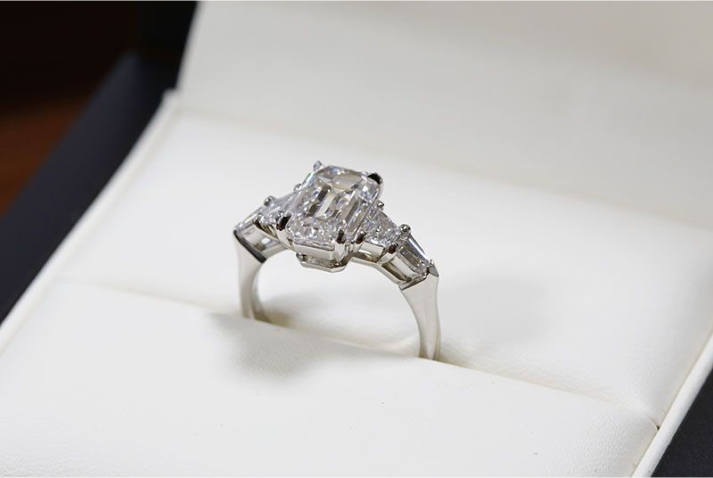
Lab-Grown Diamonds at a Glance — Reasons to Choose Lab-Grown Diamonds
Before we dive into a more detailed look at lab diamonds, here’s an overview of why someone might choose a lab diamond over a natural diamond:
Ethical Concerns
Lab-grown diamonds are not mined from the earth, which means they do not contribute to environmental damage or social injustices often associated with diamond mining.
Cost
A lab diamond is typically more affordable than a natural diamond since it is created in a laboratory rather than mined from the earth.
Quality
Lab diamonds are chemically, physically and optically identical to high-quality natural diamonds, so they offer the same quality and beauty.
Customisation
Lab-grown diamonds can be created in various colours, including blue, yellow and pink. This allows for greater customisation and the ability to create unique, one-of-a-kind lab-grown diamond jewellery.
Availability
Lab-grown diamonds are more readily available than natural diamonds, which can take millions of years to form naturally.
Future Value
While the value of natural diamonds may fluctuate over time, lab diamonds are likely to maintain their value due to their increasing popularity and availability.
How Are Diamonds Grown in a Lab?
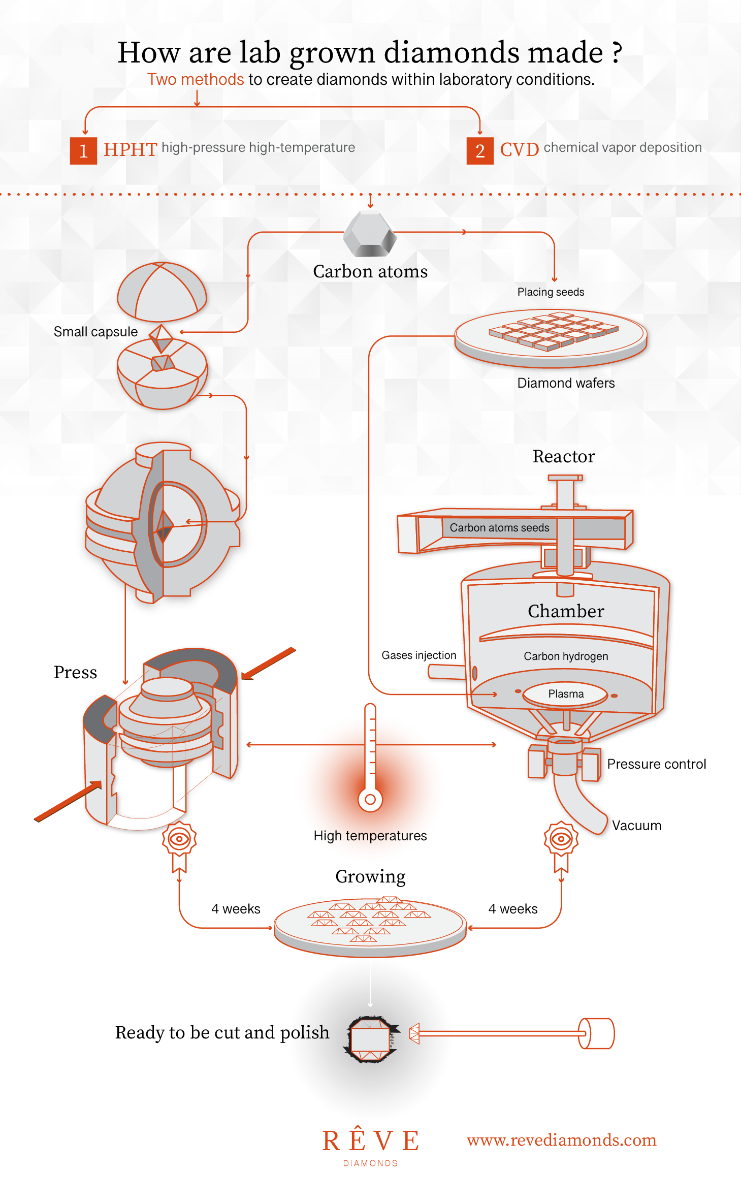
Two methods have been developed to create diamonds in laboratory conditions. These are high-pressure, high-temperature (HPHT) and chemical vapour deposition (CVD). In both processes, a diamond crystal or plate is used as a seed to initiate the growth of the lab-grown diamond.
How Are Lab-Grown Diamonds Created by HPHT?
The HPHT method most closely replicates the natural diamond formation process within the earth.
Three manufacturing processes make HPHT lab diamonds. These are the cubic press, the belt press and the split sphere press. Each of these is the vehicle that creates the intensely high temperature and pressure that facilitates diamond growth.
To begin the process, a small diamond seed is placed within a growth chamber inside a press into a carbon source such as diamond powder or graphite. It is exposed to very high heat and intense pressure, which causes the carbon source to melt into molten metal.
The carbon atoms then pass through the metal and crystallise to form a diamond around the diamond seed. The next part of the process is cooling, after which the lab-grown diamond can be transformed by cutting, polishing and shaping it into its desired form.
How Are Lab-Grown Diamonds Created by CVD?
The Chemical Vapour Deposition (CVD) technique is a more recently developed method of creating lab-made diamonds from a hydrocarbon gas mixture.
A thin slice of diamond seed is first placed into a sealed chamber, which is heated to approximately 800 degrees Celsius. A carbon-rich gas (generally methane) and other gases are then released into the chamber. These gases are ionised into plasma, which breaks the molecular bonds within them, using lasers, microwaves or alternative techniques. Pure carbon then sticks to the diamond seed, which slowly builds up to form a lab-grown diamond crystal.
As with HPHT, crystallisation of the diamond occurs anywhere between several weeks and months, and the time left for growth determines the size of the lab-created diamond. The number of crystals produced depends on the number of seed plates and the chamber’s size. They often have a rough edge of black graphite and display a brown colouration that can be removed by heat treatment before the synthetic diamond is faceted.
The Difference Between CVD and HPHT Lab-Grown Diamonds
Synthetic diamonds made by CVD have different gemological properties than HPHT lab-created diamond material.
Lab-grown coloured diamonds created using the HPHT process often exhibit uneven colouration. This is because impurities like nitrogen or boron are incorporated into the synthetic diamond during formation. Natural diamonds occasionally show some colour zoning, but this is not in the geometric pattern of HPHT lab-created diamonds. Colour zoning in coloured HPHT lab-grown diamonds relates to the different crystal faces, resulting in patterns different from natural diamonds. In contrast, CVD-created synthetic diamonds typically exhibit relatively even colouration and banded strain patterns, and they have high clarity with few, if any, slight dark carbon inclusions.
In HPHT lab-created diamonds, one can often see the inclusion of solidified flux metal. This manifests as black and opaque in transmitted light but displays an almost metallic lustre in reflected light. This is caused by the flux metal alloy used to grow the lab-grown diamond, containing nickel, cobalt and iron. You can pick up synthetic diamonds with a high proportion of metallic inclusions with a magnet. Lab-grown diamonds created by CVD form differently, so they do not have metallic inclusions. Some natural diamonds contain dark inclusions of graphite or another mineral, but these inclusions do not have a metallic lustre.
Lab-Grown Diamonds vs Natural or Real Diamonds
How Do Lab-Grown Diamonds Differ From Natural Diamonds?
While both kinds of precious stones are created by the same primary process and have the same fundamental structure, lab-created diamonds differ from natural diamonds. The main observable difference between lab-created diamonds and natural, mined diamonds is in the clarity of the stones.
The process of HPHT is said to produce diamonds that are far more robust and hard-wearing than natural diamonds. To the naked eye, they are essentially the same.
Lab-Grown Diamonds vs Natural Diamonds — How to Tell the Difference
| Lab Grown | Appearance | Natural |
|---|---|---|
| Carbon | Chemical composition | Carbon |
| 10 | Mohs scale hardness | 10 |
| 10 | Dispersion | 10 |
| 3.52 | Density | 3.52 |
| 2.42 | Refractive index | 2.42 |
| Cubic | Crystal structure | Cubic |
With the increase in the production of synthetic diamonds for use in jewelry, there has been a vast improvement in the color and clarity of lab-created diamonds — and an increase in carat weight. Gemologists and jewelers admit that with the improved quality of lab-grown diamonds, it is becoming more difficult to differentiate between these lab-produced gemstones and their natural counterparts as their chemical and physical properties are similar.
Read our guide on the differences between natural and lab-grown diamonds
However, for the past 30 years, the Gemological Institute of America (GIA) laboratory has extensively analyzed and studied synthetic diamonds to enable them to tell them apart from natural diamonds. The GIA reports that they have only seen a small number of lab-grown diamonds submitted unknowingly for their official grading reports.
Distinctive Features of Lab-Grown Diamonds
This GIA lists many of the distinctive visual features of the two kinds of synthetic diamonds:
- HPHT Synthetic / CVD Synthetic
- Uneven colour distribution / even colour distribution
- Graining patterns / no graining patterns
- Unusual fluorescence colours
- Fluorescent colour patterns
- Occasional phosphorescence
- Metallic flux inclusions / occasional dark pinpoint inclusions
- No strain patterns / banded strain patterns
- Possible inscription on girdle
These visual features identified by the GIA are based on the characteristics displayed by a number of these lab diamonds. However, it is worth bearing in mind that — like natural diamonds — not all lab-created diamonds will display all of these features. Therefore, identifying a synthetic diamond should be based on the diamond evidencing as many specified features as possible.
The Best Way to Determine if a Diamond Is Natural or Lab-Grown
If a natural diamond is examined between two polarising filters placed at a 90-degree angle, it will often display a bright cross-hatched or mosaic pattern of interference, or “strain” colours. This occurs because of the stresses placed upon the natural diamond while it forms in the earth’s mantle or during its eruption to the surface. As lab-grown diamonds form in a controlled environment, with no fluctuations in pressure or changes in stress levels, they exhibit no strain or weak-banded strain patterns.
The GIA has identified the major issue in the differentiation of tiny diamonds — or melee — which can include both natural and lab diamonds. To assist the jewellery trade in overcoming this issue, the GIA has developed an automated instrument for testing minute diamonds. As part of its ongoing research into lab-created diamonds, the GIA has recently set up a CVD growth facility to produce its own synthetic diamonds for study.
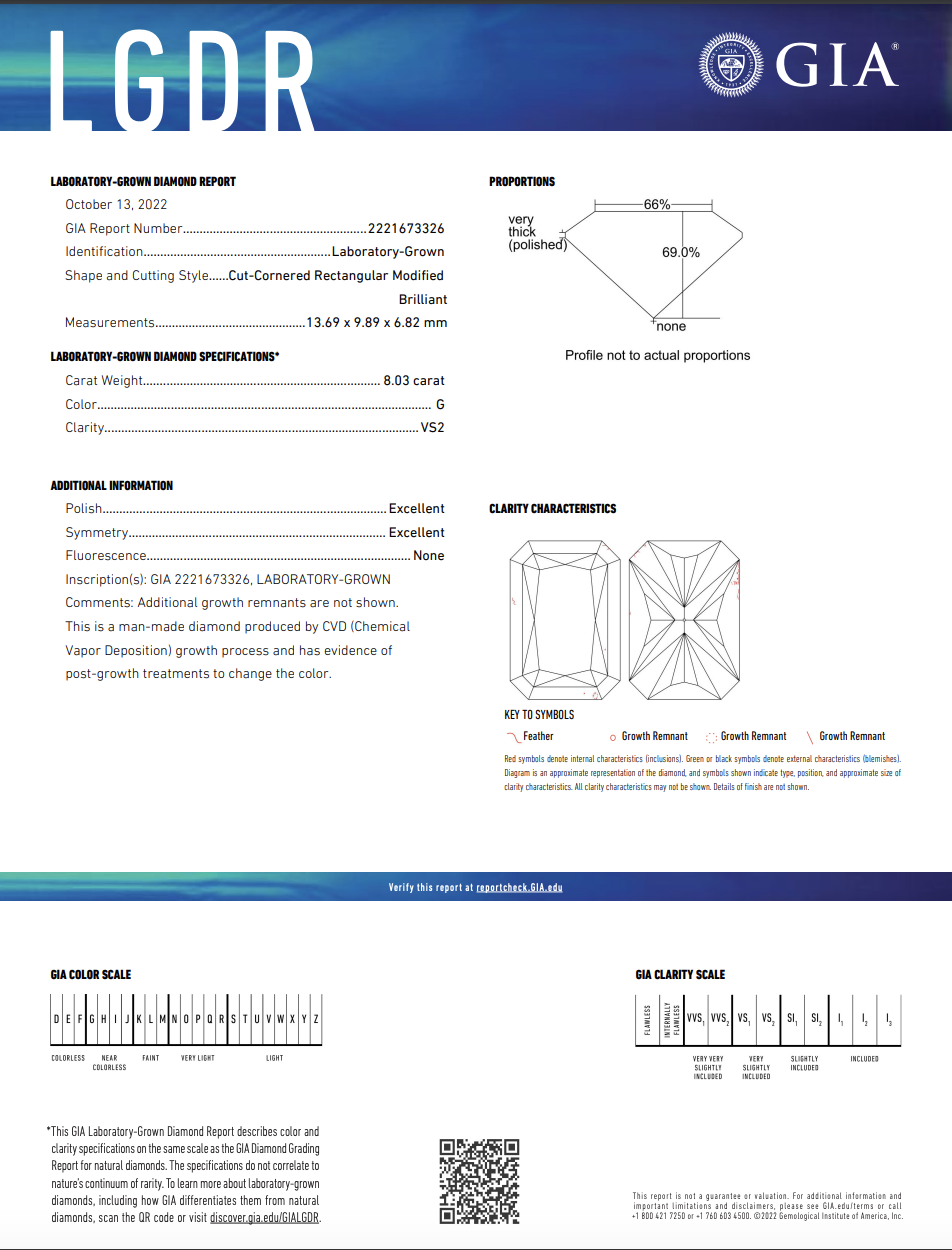
The best way for a consumer to determine whether a diamond is natural or lab-created is to request a certificate upon purchasing the gemstone. You should not buy diamonds that are not accompanied by such a document. Diamond certificates (see below) issued by the GIA or International Gemological Institute (IGI) will indicate if the stone is a lab-grown or a mined diamond.
Read our natural vs lab-grown diamonds guide
Types of Lab-Grown Diamonds
Lab-grown diamonds are created in a laboratory rather than being mined from the earth, but like natural diamonds, they can be shaped into various cuts. Some of the most popular cuts for lab-grown diamonds include:
Round-Cut Lab-Grown Diamonds
This is the most popular cut for diamonds, including lab-grown diamonds. The round cut has a circular shape with 58 facets, which allows it to sparkle and shine.
Princess-Cut Lab-Grown Diamonds
The princess cut is a square or rectangular cut with pointed corners. It has a modern, elegant look and is a popular choice for a diamond engagement ring.
Cushion-Cut Lab-Grown Diamonds
The cushion cut has a soft, pillow-like shape with rounded corners. It is known for its romantic, antique look and is often used in vintage-style jewellery.
Emerald-Cut Lab-Grown Diamonds
The emerald cut has a rectangular shape with step-cut facets, giving it a unique, angular appearance. It is a popular choice for lab-created diamonds because it tends to showcase the clarity of the diamond.
Oval-Cut Lab-Grown Diamonds
The oval cut is a modified round cut with an oval shape. It is known for its elongated, elegant appearance and is a popular choice for engagement rings.
Lab-grown diamonds can also be cut into other shapes, including pear, marquise, heart and radiant. The choice of cut for a lab-created diamond will depend on the personal preference of the wearer and the style of the jewellery in which it is set.
Where to Buy Lab-Grown Diamonds — Rêve Diamonds
Rêve Diamonds is one of the top destinations for those looking to buy lab-grown diamonds that are as beautiful and luxurious as natural diamonds. With our unparalleled selection of cuts, colours and carat sizes, you can easily find a stunning diamond you’ll love without breaking the bank. You don’t need to worry about losing out on quality either; all our lab-created diamonds have the same physical, chemical and optical qualities as natural diamonds — at only a fraction of the cost.
But alongside our excellent collection of lab-grown diamonds, we also offer:
30-Day Return Policy
If you wish to return an item, get in touch and we will process the return for you. Unlike some of our competitors, if you are not completely satisfied with your purchase within 30 days of receiving your item for any reason, we will refund your money, no questions asked.
Free Worldwide Delivery
Rêve Diamonds offers free, secure shipping on each order. Orders are shipped using the fastest delivery option available in your area. Please see here for our estimated delivery times for our different collections.
Free Insurance Valuation
At Rêve Diamonds, we understand that your jewellery is more than just a material object — it symbolises your love and commitment. That's why we offer a complimentary insurance valuation certificate with every purchase.
Shop Lab-Grown Diamond Rings
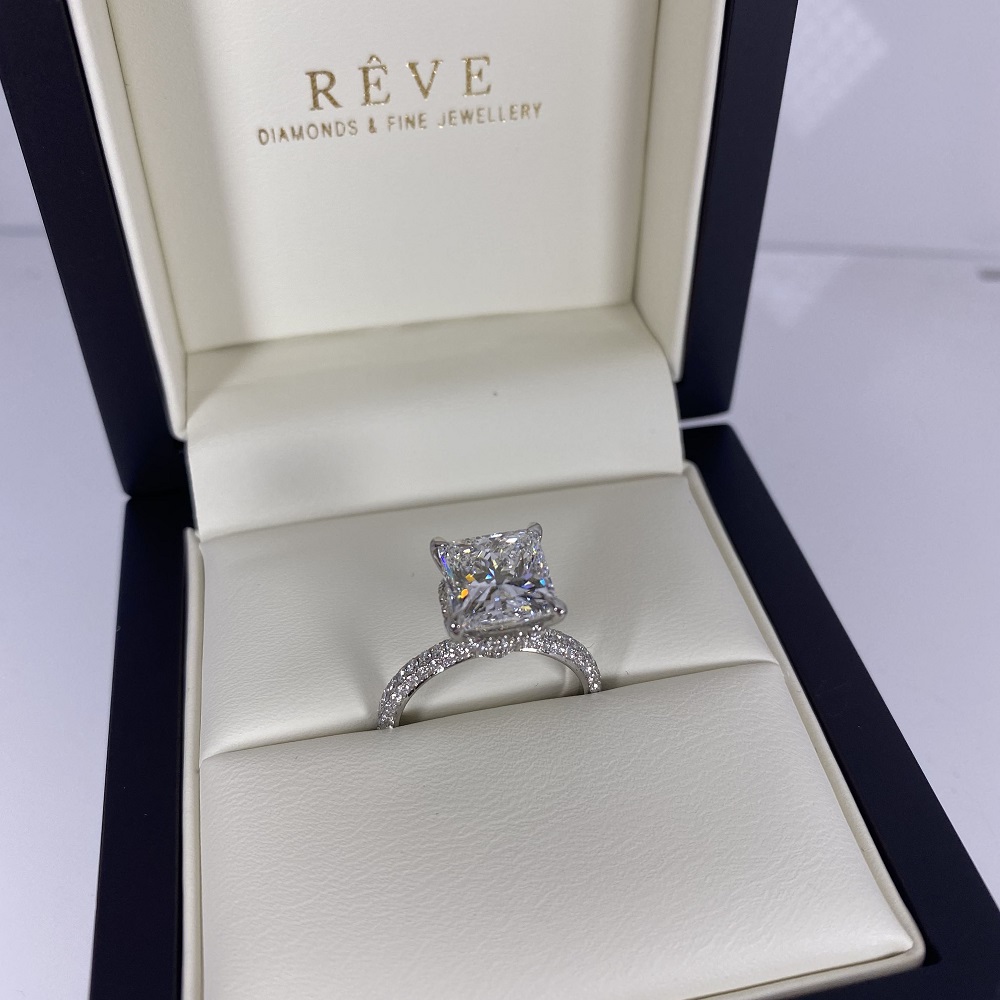
Planning a proposal means finding the perfect ring. Rêve Diamonds offers an extraordinary range of lab-grown diamond engagement rings, making it easy to find the unique symbol of your love for your special someone.
Shop Lab-Grown Diamond Tennis Bracelets
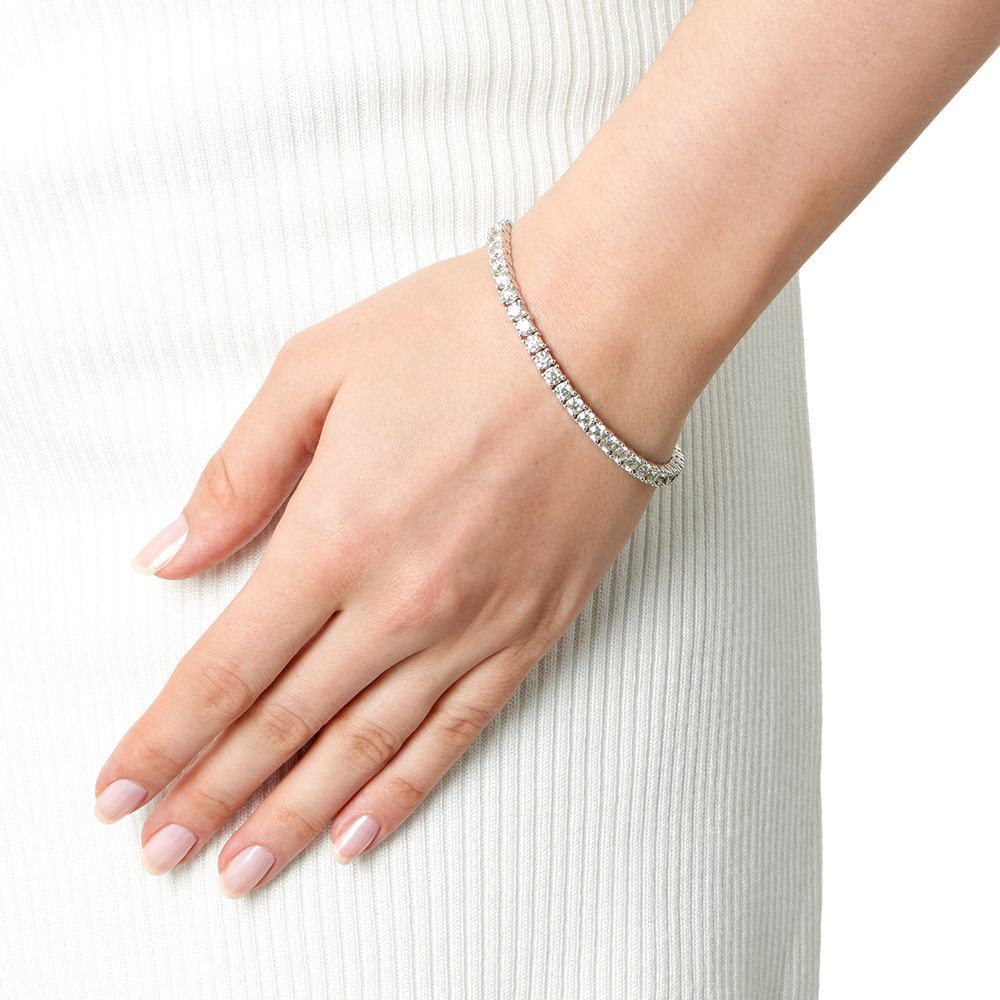
Rêve Diamonds offers the chance to own a timeless symbol of luxury with our lab-grown diamond tennis bracelets. Crafted from ethically sourced diamonds and set in elegant metals, these perfect pieces make a special addition to your jewellery collection.
Explore our collection of lab-grown diamond tennis bracelets today.
Lab-Grown Diamonds: Frequently Asked Questions
Is a lab-grown diamond a real diamond?
Yes, a lab diamond is a real diamond. It has a similar diamond crystal structure as a natural diamond, as it is made from the same material — carbon. The big difference between lab-grown diamonds and natural diamonds is how they are made. While natural diamonds are formed over billions of years deep in the earth’s mantle, lab-created diamonds are created in a much shorter time in a lab using advanced technology. Certifying and grading lab-grown diamonds uses the same criteria as natural diamonds.
Are lab-grown diamonds valuable?
While lab-grown diamonds are usually priced lower than natural diamonds, they are valuable. The rarity of natural diamonds increases their value, but lab-created diamonds can still have significant value, especially to anyone who values ethical and sustainable sourcing of diamonds. The value of a lab diamond is based on the same criteria as a natural diamond — carat, colour, clarity and cut. It’s important to remember when shopping for diamonds that value and price don’t always correspond and the true value of a diamond is based on its meaning to you or the person you’re buying for.
Can a jeweller tell if a diamond is lab-grown?
Yes, a trained and experienced jeweller with the correct equipment can tell if a diamond is natural or lab-grown, but it’s tricky to do with the naked eye. As they have the same physical, chemical and optical properties as natural diamonds, jewellers often need specialist equipment to distinguish lab-created diamonds. One of the big differences between natural and lab diamonds is imperfections. Natural diamonds often have strain colours from the environment in which they formed, while lab-grown diamonds do not.
Do lab diamonds break easily?
No, lab-grown diamonds do not break easily and are no more likely to break or chip than natural diamonds. Diamonds are one of the hardest materials on earth and rank 10 on the Mohs scale of mineral hardness, whether they are natural or lab-grown. This means that both types of diamonds are resistant to scratching and breaking.
How long do lab-grown diamonds last?
As lab-grown diamonds are identical to natural diamonds in terms of their build-up, they have the potential to last for the same amount of time — this can be generations with proper care. If you buy a lab-created diamond, it’s important to take care of it. Over time, all diamonds can be scratched or dulled. If this happens, you can take it to a professional jeweller for inspection and maintenance.
What is a lab-grown diamond?
A real diamond grown in a laboratory rather than mined. It has the same chemical, physical and optical properties as a natural diamond.
Are lab-grown diamonds real diamonds?
Yes. They are graded on the same 4Cs by the same laboratories (GIA, IGI) as natural diamonds. Only their origin is different.
Are lab-grown diamonds cheaper than natural?
Usually, yes — typically 70 to 90 percent less for the same shape, carat, colour, clarity and cut.
Do lab-grown diamonds hold their value?
Resale value is currently low because lab-grown prices have fallen as supply has scaled. They are best bought for the stone you get today rather than as an investment.
How are lab-grown diamonds made?
Two methods, HPHT (high pressure, high temperature) and CVD (chemical vapour deposition), recreate the conditions in which natural diamonds form.
We know that picking a diamond is a big decision. If you’ve got any questions, we’re here to help: book an appointment or call us.
Find Your Lab-Grown Diamond at Rêve Diamonds Today
Are you looking for a diamond that is truly out of this world? Look no further than Rêve Diamonds.
Our stunning selection of lab-grown diamonds is second to none and provides the perfect luxury choice for all your special occasions. With every detail taken into consideration, these diamonds are designed to reflect timeless beauty, with their superior clarity, colour and brilliance.
Plus, as we’re both a wholesaler and retailer, our diamonds come at a fraction of the cost of our competitors. So get ready to sparkle — and find your perfect diamond at Rêve Diamonds today.
Get in Touch With Our Experts
Live Chat
Use our Live Chat facility on the bottom right of your screen to talk to a jewellery specialist in real-time.
Call Us
Give us a call and speak to an engagement ring expert directly: 020 3585 2295.
Book an Appointment
Our loose diamonds and engagement rings are available to view in person in our London showroom. Book an appointment.
WhatsApp Us
Prefer to speak to a jewellery expert through instant messaging? Send us a message today.
Email Us
Email info@revediamonds.com to book an appointment or get the advice you need.
