Marquise Cut Diamond
Marquise Cut diamonds which are also often referred to as “navette” diamonds, translated from French as “little ship” due to the marquise diamond’s boat-like shape, are a rarer cut than many other diamond shapes. Perhaps due to this factor, they also tend to less popular than other diamond cuts such as the Round or Princess Cuts. However despite this, Marquise Cut diamonds make an elegant and sophisticated centerpiece with their shape having the effect of elongating small fingers, but looking equally as beautiful on longer, slender fingers.
In short: The marquise cut (or navette) is a boat-shaped diamond with 56-58 facets and pointed ends — designed for Madame de Pompadour in the 18th century and named for the marquise rank. It faces up the largest of any cut at a given carat (10-15% bigger than round). Aim for length-to-width 1.85-2.10 and a faint or absent bow tie. V-tip prong settings protect the vulnerable points.
Whilst the Marquise Cut began as being a cut for diamonds, it is also now seen with other gemstones such as sapphires, rubies and emeralds. Here though, we take a closer look at the beauty of Marquise Cut diamonds.
THE HISTORY OF MARQUISE CUT DIAMONDS

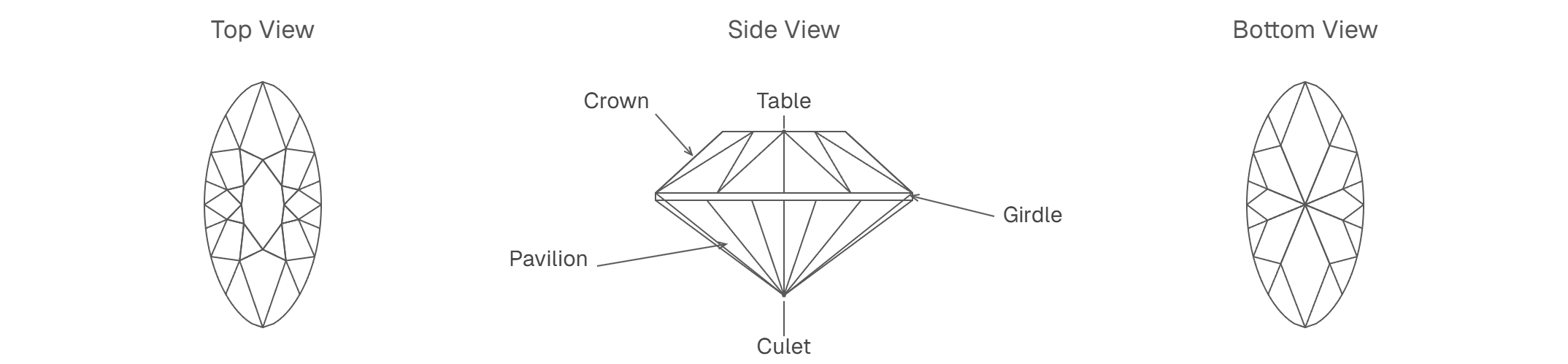
CHARACTERISTICS OF MARQUISE CUT DIAMONDS
PROS AND CONS OF MARQUISE CUT DIAMONDS
- Marquise Cut diamonds give the illusion of looking larger than other diamond cuts so appealing to those who are looking for a diamond that draws attention to itself.
- The shape of Marquise Cut diamonds means that they accentuate the fingers to make them look slimmer and longer.
- Marquise Cut diamonds cost up to 10% less than Round Cuts which means that they are ideal for the budget conscious buyer, or the saving can be used to buy a Marquise Cut diamond with a higher carat, clarity grade or color.
- Being a modified brilliant cut, Marquise Cut diamonds maximize the way in which light is refracted and reflected. This means that they can disguise inclusions that would normally be visible in diamonds cut with less brilliance such as step cut diamonds. These imperfections appear as white feathers, black spots or twinning wisps. The white light that reflects off a Marquise Cut diamond back to the viewer will cover such on the outside or inside of the diamond so making them appear eye-clean.
- Most Marquise Cut diamonds exhibit the undesirable “bow tie effect” which shows as black lines across the middle of the diamond which resemble the shape of a bow-tie. The degree of visibility of this bow tie changes depending on the quality of the diamond and it may or may not be visible to the naked eye. What this effect does however, is impact on both its brilliance and appearance so beware of paying too high a price for a diamond with this obvious flaw.
- Marquise Cuts are often up to 20% more expensive than other fancy shapes such as Baguette, Emerald, Cushion, Radiant or Asscher. They are however less expensive than Round Cut.
- The pointed ends of Marquise Cut diamonds are prone to chipping against a hard surface which will diminish its durability and longevity. This can be overcome by protecting the weak areas with a string setting such as a bezel setting or a V prong with four other prongs.
- The color quality of Marquise diamonds is graded on the extent of the presence of brown or yellow or tints, colorless being the highest grade. Marquise Cut diamonds hide color better than many step-cut diamonds, due to having narrow shallow ends which work to show tints of yellow even in a diamond with a colorless middle.
- The GIA do not cut grade Marquise Cut diamonds due to it being a fancy shape. As there are too many variations of fancy shape diamonds, the GIA have not yet developed a standard for grading their cut quality of fancy.
DO MARQUISE CUT DIAMONDS REPRESENT GOOD VALUE FOR MONEY?
Marquise diamonds: frequently asked questions
What is a marquise diamond?
An elongated shape with pointed ends, like a football or an eye. It has one of the largest surface areas of any shape for its weight.
Does a marquise look bigger?
Yes — it looks larger than almost any other shape of the same carat, and its length elongates the finger.
What should I look for in a marquise?
Check for a bow-tie across the center and protect the two points with V-tip prongs. A ratio near 1.85–2.10 is classic.
Is a marquise good value?
Yes — maximum size per carat and a regal, distinctive look at a lower price than a round.
