The Asscher Cut Diamond
Although not one of the most well known, or perhaps the most continually popular of diamond cuts, the Asscher Cut is steeped in history and still chosen by many for its brilliance, shine, and sparkle, which is often referred to as a ‘hallway of mirrors’.
In short: The Asscher cut is a square step-cut diamond with 58 facets, X-shaped from above and cropped corners. Designed by Joseph Asscher in 1902 (Royal Asscher updated to 74 facets in 2001), it favors clarity over sparkle — pick VS2 or higher and a length-to-width ratio of 1.00-1.05. Mohs 10 hardness suits daily engagement-ring wear. Lab-grown Asschers run 60-80% below natural equivalents.
In recent years the Asscher Cut has seen a resurgence with the growth in popularity of vintage jewelry and the Art Deco style. The Asscher Cut epitomizes this era and is reminiscent of old school glamour. Many Hollywood celebrities such as Jessica Alba and Gwyneth Paltrow have chosen the Asscher Cut for their engagement rings which has no doubt added to its rising popularity.
This cut is truly versatile and appeals to both Art Deco and vintage style rings as well as suiting more contemporary designs. So let’s take a close look at Asscher Cut diamonds.
THE HISTORY OF ASSCHER CUT DIAMONDS

CHARACTERISTICS OF ASSCHER CUT DIAMONDS
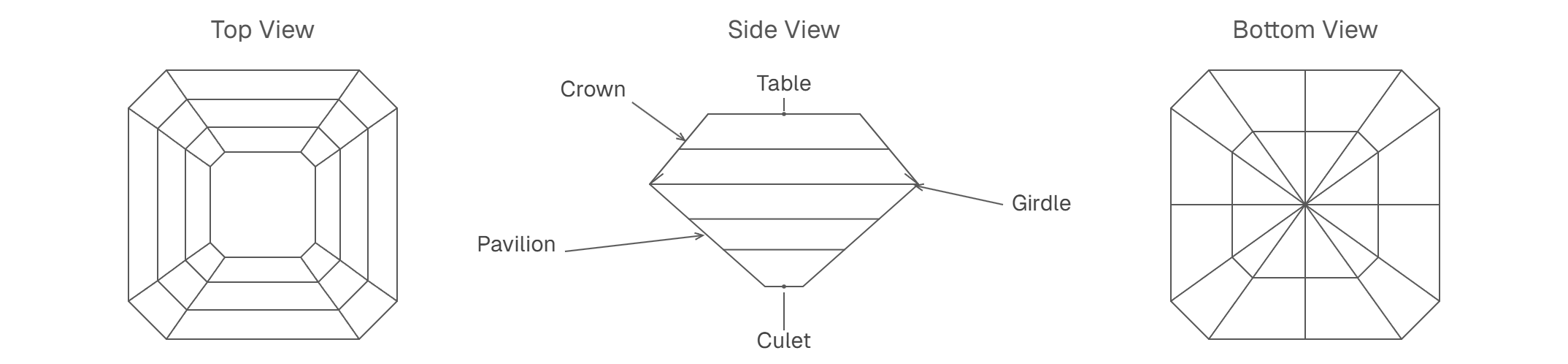
PROS AND CONS OF BUYING ASSCHER DIAMONDS
- The Asscher Cut diamond has no sharp corners which make it the ideal choice for those with an active life as it is less vulnerable to chipping if knocked or dropped. Placing the Asscher Cut diamond in a four prong setting that holds each edge will give it even more protection and stability.
- This cut of diamond has a lower cost per carat in comparison to Round Cut diamonds. Round Cut diamonds command a higher price than Asscher Cut due to 2 factors - high demand, and the fact that in cutting much of the rough diamond is wasted. Therefore Asscher diamonds tend to be up to 40% less per carat than Round Cut diamonds as they are not effected by these factors.
- The clean and elegant lines, and long rectangular facets of the Asscher Cut diamond maximize light reflection and refraction giving off large flashes of light making for a show stopping diamond.
- For those who love vintage style diamond jewelry, the Asscher Cut is the perfect choice. This cut of diamond was the most popular during the Art Deco period of the 1920s, and even in today’s jewelry designs the Asscher Cut still reflects back to the days of the Roaring Twenties.
- Asscher Cut diamonds are known for exhibiting low levels of brilliance. Brilliance is used to describe the white light that reflects off the diamond and back to the eye when the diamond is moved round. Asscher Cut diamonds exhibit lower brilliance than other Brilliant Cuts due to its step-cut facets. The elongated shape of Asscher Cut diamonds is not ideal for light collection and refraction, whereas the triangle or kite shaped facets of Brilliant Cuts are very conductive to this. Therefore if a diamond’s sparkle is an important factor in your choice, an Asscher Cut diamond may not be for you.
- Bearing in mind that colorless diamonds are the most valuable with quality declining as hues of brown or yellow are present, the fact that Asscher Cut diamonds show more color than other cuts is a definite disadvantage. The reason for this is due to the Asscher Cut diamond’s lack of brilliance which means that the yellow isn’t disguised by the white light, plus the deep cut if the diamond exaggerates the color. Finding an Asscher Cut diamond that is naked eye colorless would mean that you would need to select a color grade higher than, for example, a Round Cut, to achieve the same effect. This presents challenges and also added cost for higher color.
- The deep cut of an Asscher Cut diamond means that more inclusions will be shown such as feathers, twinning wisps, etch channels or cavities. Other diamond cuts which have strong brilliance better hide inclusions, whereas the Asscher cut doesn’t hide flaws. To obtain an eye clean Asscher Cut diamond the SI1 clarity grade would provide the most options, particularly for diamonds of less than one carat, for a larger Asscher Cut diamond start at VS2 grade.
DO ASSCHER DIAMONDS REPRESENT GOOD VALUE FOR MONEY
Asscher-cut diamonds: frequently asked questions
What is an asscher-cut diamond?
A square step-cut, like a small emerald cut with cropped corners, known for its concentric ‘windmill’ pattern and Art Deco character.
Does an asscher cut show clarity?
Yes — like the emerald cut, its step facets reveal inclusions, so a VS2-or-better clarity is worth choosing.
Is an asscher cut vintage?
Very much. It dates from 1902 and suits antique and Art Deco-inspired designs.
What ratio should an asscher be?
Look for good symmetry and a near-square 1.00–1.05 ratio for the classic look.
