An Oval diamond ring is ideal for those who want the sparkle of the Round Brilliant cut yet in a more elongated and unusual shape. Originating over 200 years ago, the Oval cut has progressed to become one that stuns because of its brilliance and optimises carat weight. Oval cut diamond rings are also loved by many because it has the ability to make the finger appear slimmer and longer.
In short: The oval cut is an elongated round brilliant with 56-58 facets — faces up about 10% larger than a round of the same carat and currently the fastest-growing engagement-ring shape in the UK (15-20% of 2025 sales). Aim for length-to-width 1.30-1.45 and a faint or absent bow tie. Mohs 10 hardness suits daily wear. Lab-grown ovals run 60-80% below natural equivalents at identical 4Cs grading.
01
AN INTRODUCTION
The Oval diamond boasts and elegant and timeless appearance; it is an elongated round shape, which falls somewhere in the middle between the
Pear shape and the Round Brilliant cut. You get all the brilliance of the latter while the unique shape elongates the finger and is ideal for those who want to stay away from the most common cuts. It is growing in popularity in terms of centre stones for engagement rings.
02
FEATURES
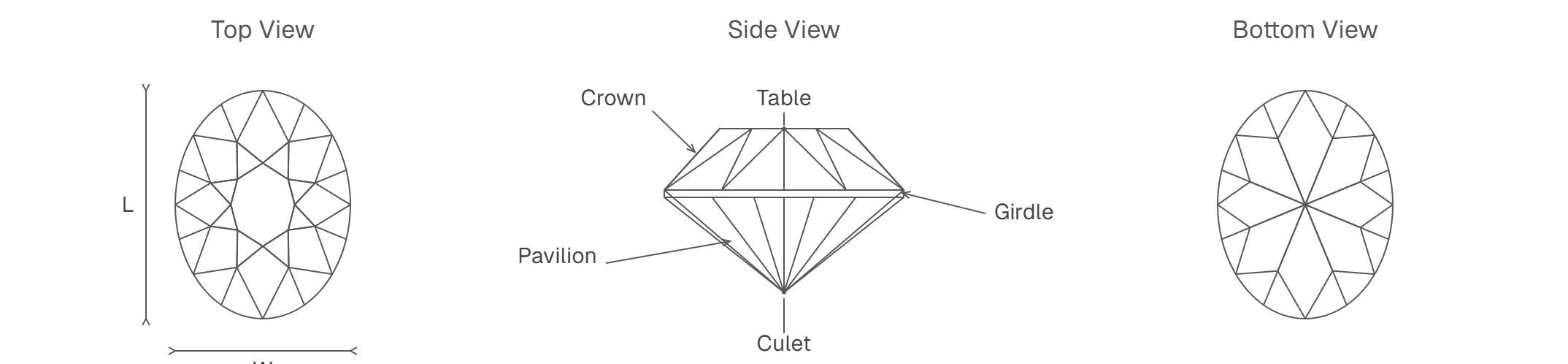
The Oval cut tends to have a length to width ratio between 1.33 and 1.66 and it features 58 facets. The bow-tie effect can occur with the Oval diamond sometimes. What this means is that a shadow can be cast across the stone’s central facets when light passes through. Altering the depth of the pavilion is a good way to reduce the bow-tie effect while another approach is to diffuse light better by adjusting the angles of the facets and the table.
03
BUYING ADVICE
One of the great things about this
diamond shape is that you can afford to go for a lower carat if need be, as the shape optimises carat weight. What this means is that it can appear larger than other shaped diamonds of the same weight. One of the most crucial factors to consider when buying an Oval
engagement ring is the length to width ratio. This is because it can have an impact on the appearance of the finger and the light dispersion in the stone. In terms of settings, a bezel
setting, six-prong setting, and four-prong setting all work well.
Similar to the
marquise, oval cut diamonds can display a bow tie effect: a dark area shaped like a bow tie in the centre of the diamond. The bow tie effect appears in some fancy cut diamonds such as marquise, hearts and oval cut diamonds. read more about the bow-tie effect on this
link.
04
HISTORY
You need to roll back the clock a couple of hundred years ago to see when the first Oval shaped diamond was introduced. However, it was not until the early 1960s that the Oval cut as we know it today came about. Lazare Kaplan, a Russian diamond cutter, is credited with creating the modern Oval cut. This is something that actually led to him having a place in the Jewellers International Hall of Fame.
Oval diamonds: frequently asked questions
What is an oval diamond?
An elongated brilliant cut with the same sparkle as a round but a longer, softer outline.
Does an oval look bigger than a round?
Yes. Its elongated shape gives more surface area, so an oval usually looks larger than a round of the same carat and flatters the finger.
What should I look for in an oval?
Watch for a ‘bow-tie’ shadow across the middle; the best ovals show little or none. A ratio around 1.35–1.50 is popular.
Is an oval good value?
Yes — brilliant sparkle, a larger look, and a lower price per carat than a round.