Anatomy of a Diamond and the Effects of Light
The anatomy of a diamond can be broken down into the following parts:
In short: A diamond's anatomy splits into table (top flat facet), crown (upper section), girdle (widest middle), pavilion (lower cone), and culet (bottom point). Light enters through the crown, reflects off the pavilion's mirror facets, and exits as fire (spectral colour) and brilliance (white light). GIA's Excellent cut grade requires near-ideal proportions — table 53-58% and depth 59-62.5% for round brilliants.
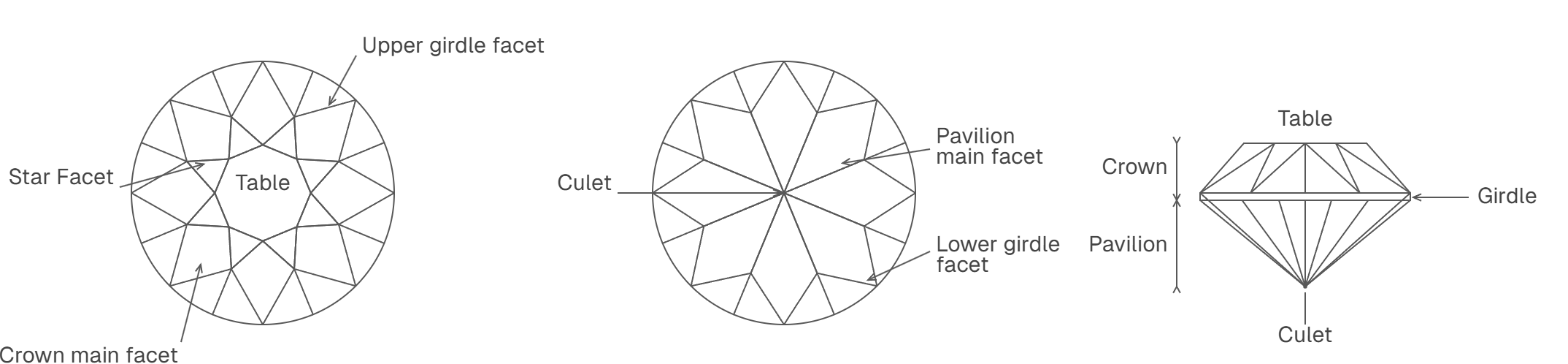
DIAMOND CROWN
The crown is the top part of the diamond, between the table and the girdle.
DIAMOND CULET
This is the bottom tip of the diamond, which is usually never on show.
DIAMOND DEPTH
The height of the diamond.
DIAMOND DIAMETER
The width of the diamond.
DIAMOND GIRDLE
This is the narrow band at the diamond’s narrow point.
DIAMOND PAVILION
The bottom part of the diamond, between the cutlet and the girdle.
DIAMOND TABLE
The largest facet at the top of the diamond.
The two main parts of the diamond that need to be considered is the pavilion and the crown. Their relationship with one and other is what determines how well the diamond sparkles.
So, what happens when the light hits a diamond that has been cut well? Well, some of the light will immediately reflect back off the crown angles while the rest of the light will enter the diamond. When it enters the diamond, it should bounce off the internal walls and then shoot back to the surface of the diamond again, creating a stunning sparkle. If the diamond has not been cut well, the light will escape.
Diamond anatomy: frequently asked questions
What are the main parts of a diamond?
A diamond has five key areas: the table (the flat top facet), the crown (the sloped top section), the girdle (the thin band around the widest point), the pavilion (the lower cone) and the culet (the tiny point or facet at the bottom).
Which part of a diamond affects sparkle the most?
The pavilion. Its angles decide whether light bounces back to your eye or leaks out of the bottom, so pavilion depth and angle matter more for brilliance than the size of the table.
What is the girdle and does it matter?
The girdle is the narrow edge where the crown meets the pavilion. A girdle that is too thin can chip, while one that is too thick hides weight you have paid for. Medium to slightly thick is the safe range.
Can you see the culet with the naked eye?
On a well-cut diamond the culet is tiny or closed, so you won't notice it. A large culet can look like a small dark hole when you view the stone straight through the table.
