Buying & Guides
How Much to Spend on an Engagement Ring
A calm, practical budgeting guide — what people really spend, where the money goes, and how to make any figure go further.
There's no real rule for how much to spend on an engagement ring — the "three months' salary" line was invented for a 20th-century advertising campaign. Set a figure that fits your finances, then make it go further by prioritising cut, choosing an eye-clean, near-colourless diamond, or picking a lab-grown stone for far more size at the same price.
Where the "rules" came from
If you've heard that you should spend one, two or three months' salary on an engagement ring, that didn't come from tradition — it came from a diamond advertising campaign in the twentieth century. It was a clever way to sell more diamonds, and it worked so well that people still repeat it today. Treat it as marketing, not a benchmark. Even so, it's proved a durable one — many couples today still use two to three months' salary as a mental starting point, which is perfectly fine as long as it stays a convenient anchor rather than a figure you feel obliged to hit.
What people actually spend
In the UK, most people spend somewhere between roughly £1,500 and £4,000 — but the range is enormous, and plenty of beautiful rings sit well below it. A national average is a poor target, because it lumps together tiny budgets and enormous ones. What matters is a figure you're comfortable with, given everything else going on in your life.
Start with a budget, not a carat
It's easy to fall in love with a specific carat weight and work backwards, but that's how budgets get stretched. Decide the total you're happy to spend — ring and setting together — and let that guide the diamond you choose. A slightly smaller, beautifully cut stone almost always looks better than a larger, poorly cut one bought to hit a number.
Budgeting by the centre stone
The biggest lever on price is the centre stone — and above all whether it's lab-grown or natural. These are honest starting ranges, not rules.
Maximum size for the money — a well-cut 1.0–1.5ct stone on a simple setting.
A larger or higher-grade stone, or a more refined setting.
A wide range, set almost entirely by the centre diamond’s carat and grade.
Where the money actually goes
Understanding how a ring's price breaks down makes it far easier to decide where to invest. As a rough guide, the centre stone dominates, the metal and setting take a meaningful slice, and design and finishing account for the rest.
Where to spend and where to save
Put cut first: it drives sparkle more than any other factor, so it's the last place to economise. Then choose an eye-clean clarity such as VS2 or SI1 and a near-colourless grade like G or H — both look flawless to the eye without paying for quality you'd need a loupe to see. A fluorescence grade of None to Faint keeps things safe, and buying just under a round weight — say 0.90ct instead of a full carat — saves a noticeable amount for a size difference nobody will spot.
Spend on
Cut grade, an eye-clean appearance, and a well-made setting that will survive daily wear.
Save on
The last colour grade or two, the jump to a round carat weight, and clarity beyond what the eye can see.
Buy an "oversize" and pay the lower price
An oversized diamond looks a lot closer to the next size up, but is still priced on the lower size's list. A 0.60ct is priced on the 0.50–0.69 list yet reads like a 0.70ct; a 1.20ct looks closer to a 1.50ct while sitting on the 1.00–1.49 list.
Oversizes may trade at a 5–15% premium over a straight size of similar quality — but still come in cheaper than the next size up at the same colour and clarity.
Diamond prices jump sharply at the carat and half-carat marks. Buying just shy of those weights can save a meaningful amount, and the slight size difference goes unnoticed.
How lab-grown changes the maths
A lab-grown diamond is chemically and optically identical to a mined one, but typically costs far less for the same look. If size or quality matters most to you, that means the same budget can buy a noticeably bigger or higher-grade stone. If rarity and long-term value matter more, a natural diamond holds its value better — but you pay a premium for that up front.
Other costs to plan for
The ring itself is the headline, but a few smaller costs are worth folding into your budget: resizing (surprise proposals rarely land on the exact finger size), insurance on a like-for-like replacement basis, and keeping the ring in proportion with the rest of your plans — a wedding band included — so it lifts the celebration rather than competing with it.
A few budget myths, cleared up
Frequently asked questions
How much should I spend on an engagement ring?
Whatever fits comfortably within your finances. There's no fixed rule — set a budget you're happy with, then spend it wisely on the things that show, like cut.
Is the three months' salary rule real?
No. It was coined by a diamond advertising campaign in the 20th century as a way to sell more diamonds, and it has no basis beyond that.
What's the average UK engagement ring budget?
Most people spend somewhere in the region of £1,500 to £4,000, though the range is very wide and there's no need to match it — many lovely rings cost less.
How can I make a smaller budget go further?
Prioritise cut, choose an eye-clean clarity and a near-colourless grade, buy just under a round carat weight, and consider a lab-grown diamond for more size at the same price.
Is it better to buy lab-grown to save money?
If size or grade matters most within your budget, yes — lab-grown gives you more for less. If rarity and resale value matter more, a natural diamond is the better fit despite the premium.
Not sure where your budget lands?
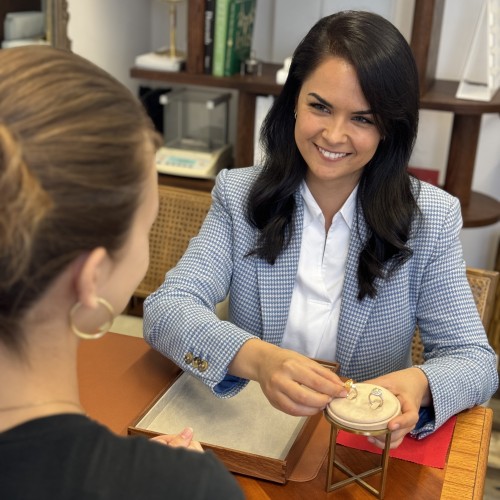
Sit down with a Rêve gemmologist — no pressure, just honest guidance on getting the most beautiful ring for your figure.