Marquise Cut Diamond
The Marquise cut is elegant and sophisticated, and many have fallen in love with its stunning appearance. This is a diamond shape that elongates the finger and also has the benefit of optimising carat weight. It is traced back to the Royal family, which is of little surprise when you consider its beautiful and refined appearance.
In short: The marquise cut (or navette) is a boat-shaped diamond with 56-58 facets and pointed ends — designed for Madame de Pompadour in the 18th century and named for the marquise rank. It faces up the largest of any cut at a given carat (10-15% bigger than round). Aim for length-to-width 1.85-2.10 and a faint or absent bow tie. V-tip prong settings protect the vulnerable points.
01
AN INTRODUCTION
The Marquise diamond can sometimes be referred to as the Navette shape. Not only does it look beautiful, but also it is ideal for couples that are on a budget, as you can afford to go for a lower carat weight. It also suits most people, as it has a slimming effect and can make small fingers look slightly longer, yet it looks just as beautiful on those with long, slender fingers.
02
FEATURES
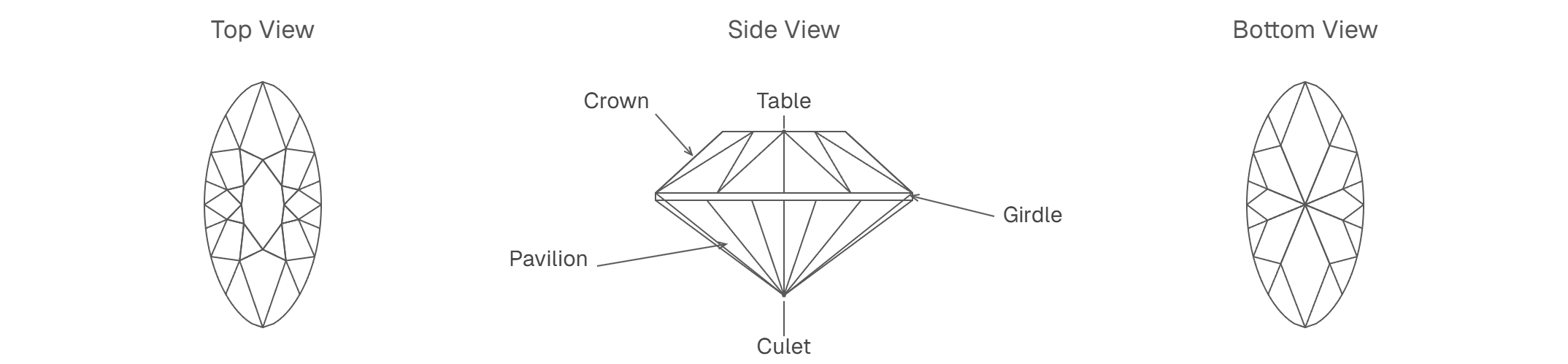
When buying a Marquise cut, the ideal length to width ratio is somewhere between 1.85 and 2.10, and most diamonds tend to have 56, 57 or 58 facets. This diamond shape can sometimes suffer from the bow tie effect, which relates to a shadow being cast across the face of the diamond when a light shines through. To ensure light does not pass through the back of the diamond, it is vital that it is not too shallow, otherwise you will lose out on fire and
brilliance.
03
BUYING ADVICE
As mentioned, one of the great things about the Marquise diamond is the fact that it optimises carat weight. This means that when contrasted with another shape of the same carat weight, a Marquise diamond will look bigger. This diamond can also hide
colour tints and inclusions to a certain extent, but you are still advised to go for a fairly high grading. The best setting for the
Marquise diamond ring is the six-prong setting, with two prongs placed at either side, one prong at the top, and another prong at the bottom.
04
HISTORY
The story behind the creation of the Marquise diamond is one of love. It was created during the mid 1700’s when King Louise XIV commissioned his court jeweller to create a diamond that would resemble the smile of Jeanne Antoinette Poisson, the Marquise de Pompadour, who was his mistress. The Marquise shape has developed considerable since then, resulting in a cut that offers more brilliance.
Marquise diamonds: frequently asked questions
What is a marquise diamond?
An elongated shape with pointed ends, like a football or an eye. It has one of the largest surface areas of any shape for its weight.
Does a marquise look bigger?
Yes — it looks larger than almost any other shape of the same carat, and its length elongates the finger.
What should I look for in a marquise?
Check for a bow-tie across the centre and protect the two points with V-tip prongs. A ratio near 1.85–2.10 is classic.
Is a marquise good value?
Yes — maximum size per carat and a regal, distinctive look at a lower price than a round.