Cut Grading
Cut grading is fairly simple under the GIA certification system, which is widely used. Two factors that heavily influence the grading are the table percentage and the depth percentage. The latter is calculated by dividing the longest table measurement by the average girdle diameter.
In short: GIA grades round-brilliant cut Excellent → Very Good → Good → Fair → Poor — combining proportions, polish, and symmetry. The metrics: table 53-58%, depth 59-62.5%, crown angle 34-35°, pavilion angle 40.6-41°. Cut Excellent stones return roughly 90% of incident light. Fancy shapes (oval, princess, emerald) carry no formal GIA cut grade — judge them by light-return symmetry and the bow-tie effect.
The depth percentage is calculated by dividing the depth by the average girdle diameter. These calculations should be done in millimetres.
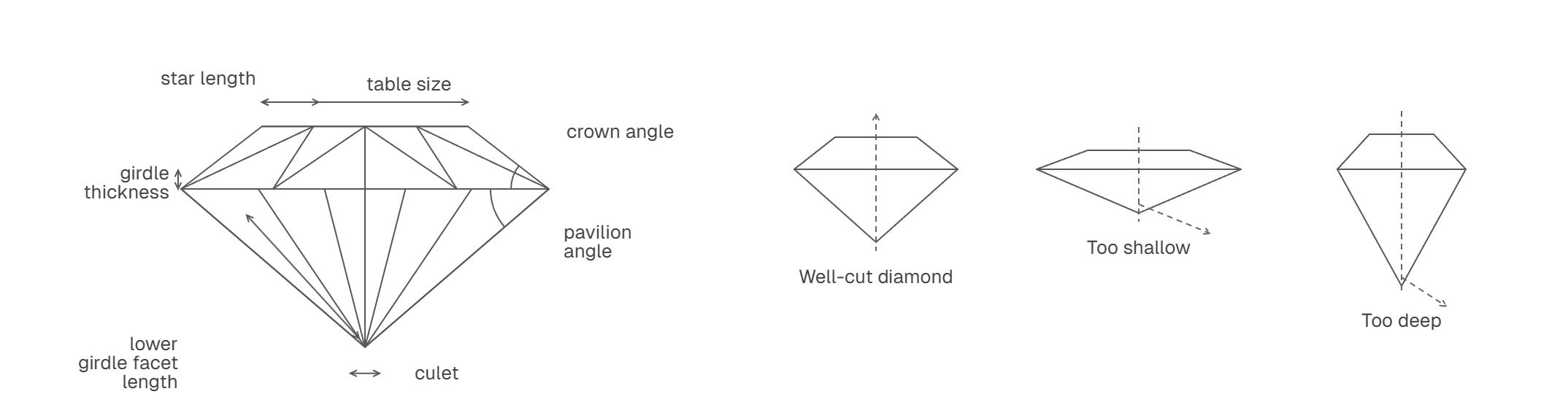
This classification ranks diamond cut from Excellent, to Very Good, to Good, to Fair or Poor. The name of each grade makes it fairly easy for you to understand the level of quality you are buying into. Fair or Poor cuts should be avoided, as this means the diamond has been cut too deep or too shallow, and thus the light will escape. On the other hand,with both Ideal and Very Good cuts, the light reflects beautifully.
The difference between the two can be very difficult to tell to the untrained eye. A lot of people tend to go for a Good cut, as this provides a good balance between quality and affordability. While some of the light does escape the diamond, a lot of it reflects for a stunning sparkle.
Beyond table and depth percentages, factors like symmetry and polish contribute to a diamond's overall cut grade. Symmetry assesses the alignment and balance of facets, while polish evaluates the smoothness of the diamond's surface. These additional elements further refine the assessment and influence the overall visual appeal of the diamond.
Diamond cut grading: frequently asked questions
What are the diamond cut grades?
GIA grades cut on a five-point scale: Excellent, Very Good, Good, Fair and Poor. The grade reflects how well the proportions, symmetry and polish work together to return light.
Is cut the same as shape?
No. Shape is the outline — round, oval, emerald and so on. Cut grade measures how well a stone has been faceted and finished. Two round diamonds can share a shape but sit worlds apart on cut.
What cut grade should I choose?
For a round brilliant, aim for Excellent or Very Good — cut has the biggest effect on sparkle, so it's the last place to save. On other shapes, use the polish and symmetry grades plus the stone's video to judge it.
Do all diamond shapes get a cut grade?
No. GIA only issues a full cut grade for round brilliants. Fancy shapes are still graded for polish and symmetry, so you judge those alongside the proportions and how the stone looks on video.
