Princess Cut Diamond
After the Round Brilliant cut, the Princess diamond is arguably the most popular. It is not hard to see why; it boasts a striking yet elegant appearance and it has the most brilliance out of all of the square shapes. It is particularly suited to those that have long fingers and aside from engagement rings this stone is often incorporated into eternity bands.
In short: The princess cut is a square modified brilliant with 57-77 facets — invented in 1980 by Basil Watermeyer in London, now the second-most-popular fancy shape (3-5% of UK engagement-ring sales). Aim for length-to-width 1.00-1.05 and sharp, V-tipped corners. The vulnerable corners need full prong coverage. Mohs 10 throughout. Lab-grown princess cuts run 60-80% below natural equivalents at identical 4Cs.
01
AN INTRODUCTION
The Princess cut is essentially a square version of the popular Round Brilliant cut; boasting the stunning fire and brilliance that is desired by all diamond lovers. When the stones are of the same
carat weight, the Princess diamond tends to be greater in length yet smaller in diameter when contrasted with the Round cut. This is ideal for those who love the brilliance and fire of the Round cut yet want something slightly different and more contemporary. Despite their unique shape,
Princess cut diamond engagement rings are extremely versatile and can be teamed with other rings with ease.
02
FEATURES
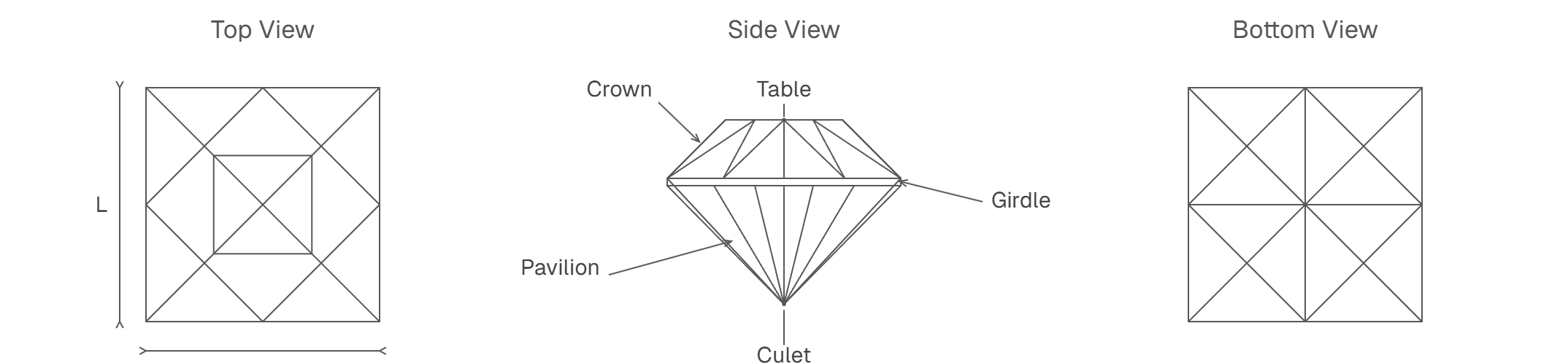
A typical Princess diamond boasts a length to width between 1.00 and 1.05 while it also compromises of either 57 or 76 facets. This cut boasts more light dispersion than any other type of square diamond and this is because of the unique shape, which is a pyramid with four bevelled sides.
03
BUYING ADVICE
Princess cut diamond rings are particularly suited to long fingers because of the sharply squared corners. This diamond shape is also more likely to show
colour tints, particularly in the corners, which is why you are advised to go for a high colour grading. In terms of grades, you are recommended to go for a minimum of the following to benefit from a high-quality diamond with a stunning sparkle; a Very Good symmetry, SI1-VS2+
clarity, and H+ in terms of colour. Princess cut halo engagement rings are exceptionally popular. This type of ring has a collection of micro pave diamonds or round pave diamonds that circle the centre Princess diamond. This creates a stunning sparkle, as the smaller stones flash with light, drawing the eye back to the centre stone.
You will find many Princess cut engagement rings in this style, from the bold and elaborate – such as those with a full diamond set band, to the more subtle designs. Take a look at our Princess cut halo engagement rings. You can expect value for money when purchasing a Princess cut diamond engagement, as they have a marginally lower price-per-carat when compared with Round cut diamonds. Finally, when it comes to the setting, you should always seek a Princess diamond that is set within four prongs to protect each corner.
04
HISTORY
From 1961, the name ‘Princess cut’ was initially associated with another shape of diamond. However, the Princess diamond as we know it came about in 1979. Its invention can be credited to three people from Israel; Betzalel Ambar, Ygal Perlman, and Israel Itzkowitz. A considerable amount of research was conducted to achieve the stunning brilliance adored by people all over the world today.
Princess-cut diamonds: frequently asked questions
What is a princess-cut diamond?
A square diamond with a brilliant-style facet pattern that gives strong sparkle. It is the most popular fancy shape after the round.
Does a princess cut sparkle like a round?
Almost — it has plenty of fire and brilliance, at a lower price per carat than a round.
What should I look for in a princess cut?
Its pointed corners can chip, so choose a setting with V-tip claws that protect them.
Is a princess cut good value?
Yes. You get a large, brilliant look for less than a round of the same weight.